Currently Planned BusConnects Network 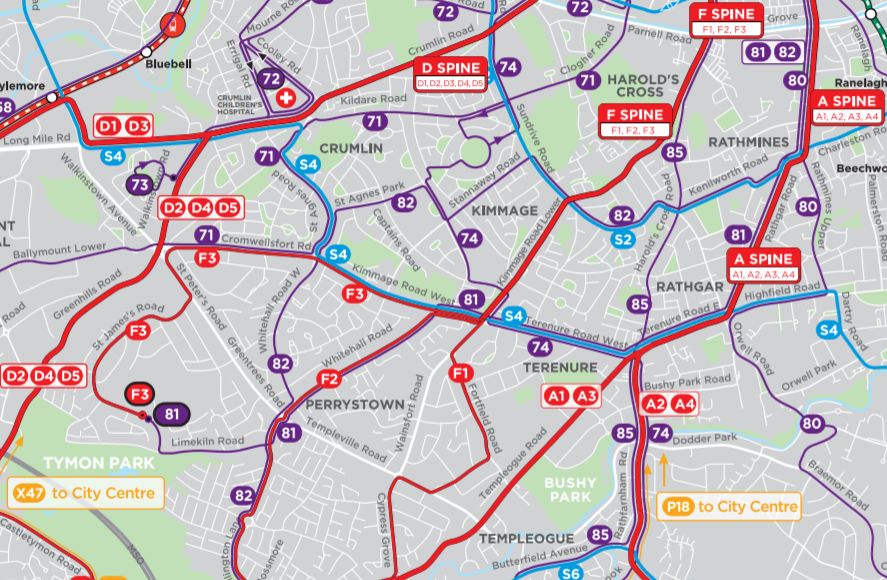
NETWORK MAP SUBMISSION: Park West/Cherry Orchard Train Station – City Centre (via Templeogue)
This article was originally posted in December 2020 (amended November 2023). The proposed route is intended to supplement our S5 route proposal for an orbital bus on the R112 Templeville Road from Cherry Orchard/Walkinstown – Blackrock.
Proposal:
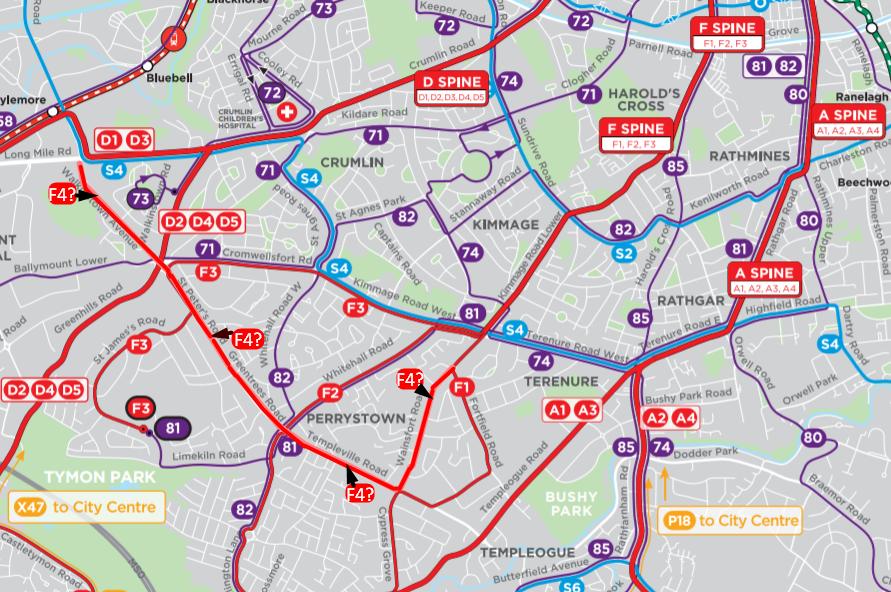
Addition of new F4 bus route to be added on Wainsfort Road to New Dublin Bus Area Network as part of BusConnects.
Route: The F4 route would join the planned F1,F2,F3 in forming the F spine from Kimmage to City Centre.
Outbound from City Centre: The F4 would follow the same route as the F spine until the KCR.
At KCR it would continue straight onto Fortfield Road and onto Wainsfort Road before turning right at the roundabout onto Templeville Road. The route would continue straight until Naas Road where it would swing left and onto Park West Avenue before terminating at Cherry Orchard Irish Rail (Dublin-Cork) line.
This would provide better public transit options to residents of Wainsfort Manor, College Square and the surrounding area, reducing car dependency and improving air quality.
Inbound towards City Centre: The route would follow the same path and at KCR the would continue on the F Spine toward city centre. The route would also help improve bus frequency of the Kimmage-City Centre corridor which is due to have several Bus Gates in operation.
Why this route?
The Network Redesign proposed as part of the BusConnects plan will leave residents of Templeogue with a sub-standard bus service that does not deliver quality public transport for residents. In some areas, the BusConnects plan will provide an inferior service even to the existing network. Having analyzed the plans, we conclude that the South Terenure/Templeogue area as a whole will have very limited services. Wainsfort Manor and College Square are two large developments with no access to bus facilities.
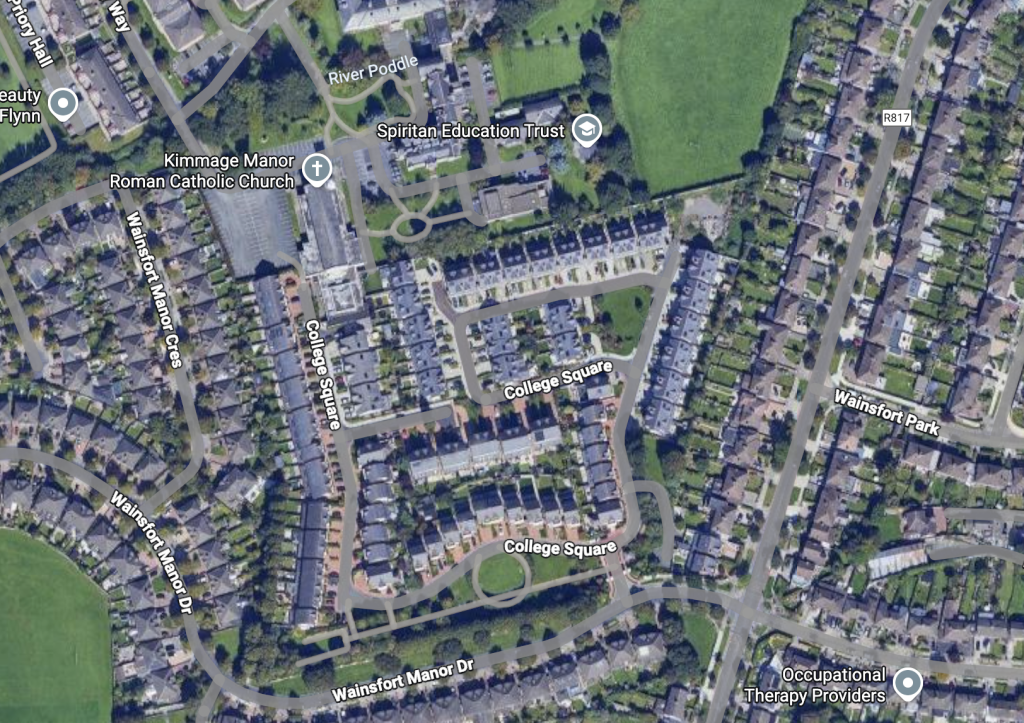
In urban residential areas bus stops should be located so as to ensure that nobody in the neighbourhood is required to walk more than 500 metres from their home. With the addition of measures like the 90 minute fare, this helps ensure that communities feel connected to the “public transport grid” and that this network can actually be beneficial to them and their families.


Property Impact of F4: No private property or driveway should be directly impacted, there is enough green space for bus stops such that it is not required to have buses block any driveways, nor would any land take from driveways be required.
Bus Stop Locations: New additional bus stops would be along Wainsfort Road, Greentrees Road, St Peter’s Road. Local input/feedback would have to be central to this with the NTA obligated to engage and publicly send representatives to meet with residents.
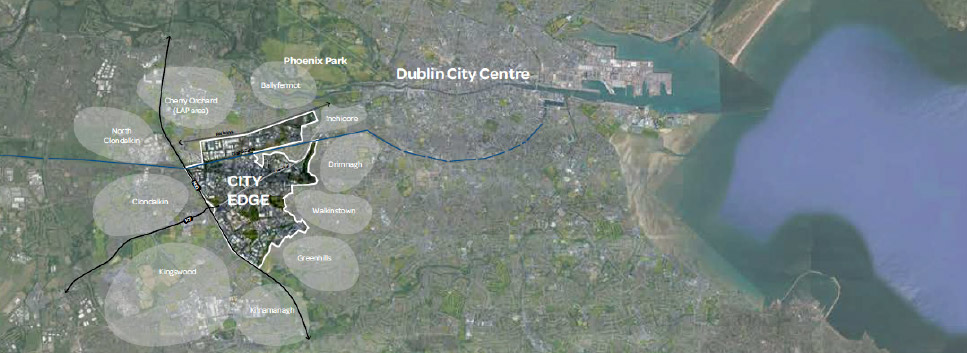
Providing for quality public transport will help safeguard the area against projected traffic increases to due planned/upcoming housing developments, such as the City Edge project and those currently being planned for Kimmage Road West and Fortfield Road.
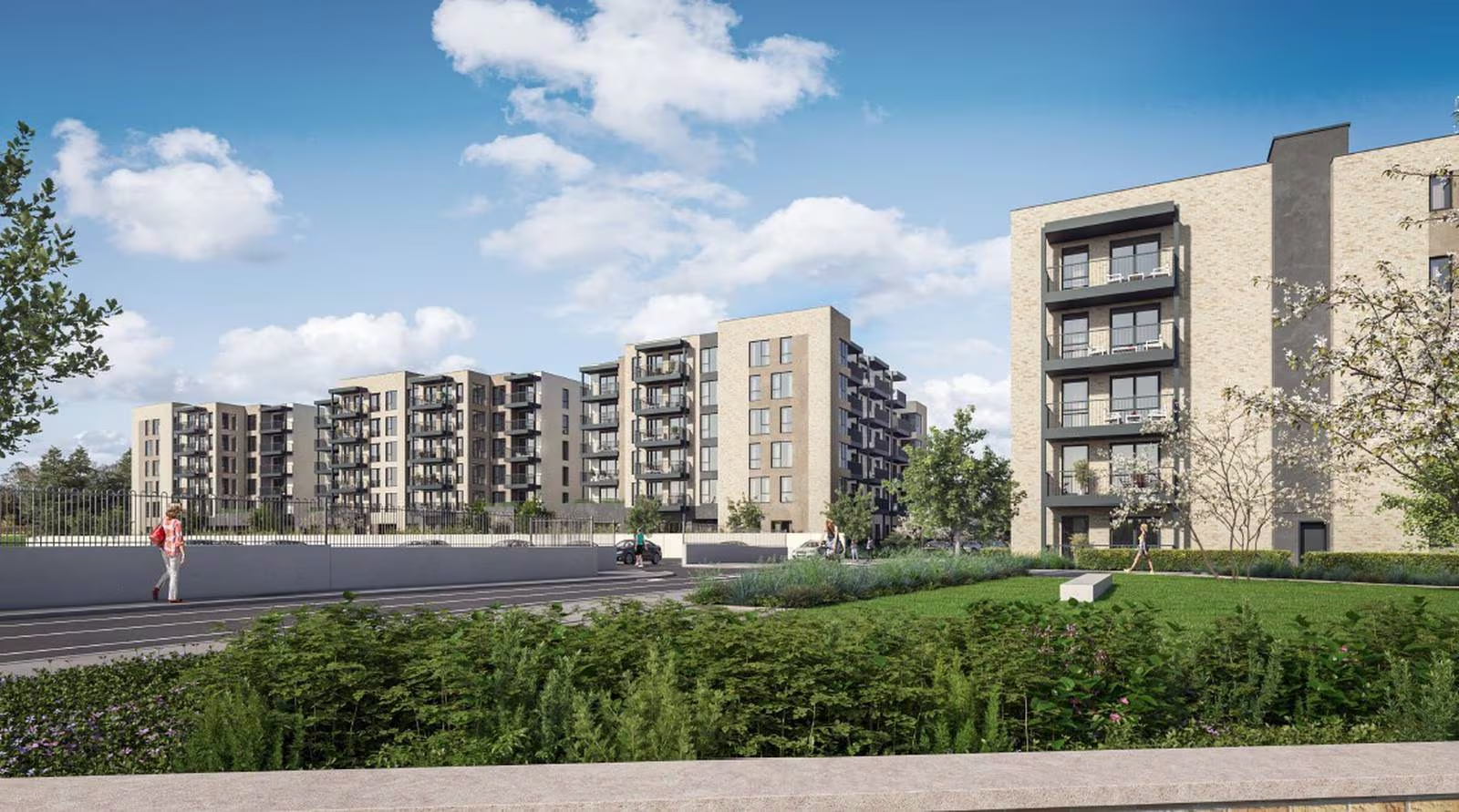
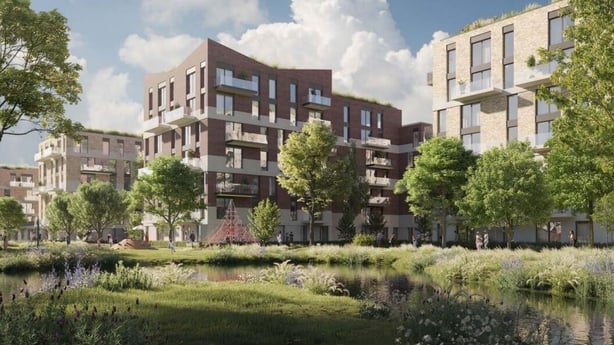
These improved public transport options will reduce and safeguard against congestion for those who really need to drive and reduce neighbourhood rat-runs at peak traffic times.
Car-centric development vs transit-led development
As well as improving city centre access, the above measures will significantly improve bus services between suburbs including links between residents and a number of schools such as St Pauls Greenhills, Holy Spirit Limekiln, Bishop Galvin/Shanahan, Templeogue College, and St Pius X National School. Areas that are currently underserved by Dublin Bus such as Wainsfort Manor and Greentrees Road would now have a direct and frequent line to the city which they didn’t have previously.

We would expect the frequency of the F4 to be in line with the other routes of the F spine as below. The F spine as per the BusConnects Network Overhaul was due to come into place in Spring 2023. It has been significantly delayed, in part due to the knock-on effect of staff shortages.
See Bus Connects Frequency Tables

Noise and Traffic Impact: The above proposals will also result in a net reduction of vehicular traffic in the area. It is also worth noting that Dublin Bus is already in the process of transitioning to a fully electric fleet which should help address concerns about the noise/pollution from such vehicles. Depending on demand, the bus could potentially run as a single deck vehicle also.

With a larger number of journeys accessible by bus, including to various schools, the amount of private traffic on our streets could decrease significantly, particularly at peak times. When even a small number of people opt for public transport or active travel instead of driving, it frees up a significant amount of roadspace on constrained roads, allowing public transport to thus operate more efficiently which in turn drives further demand whilst making roads less congested for those will still need to drive.
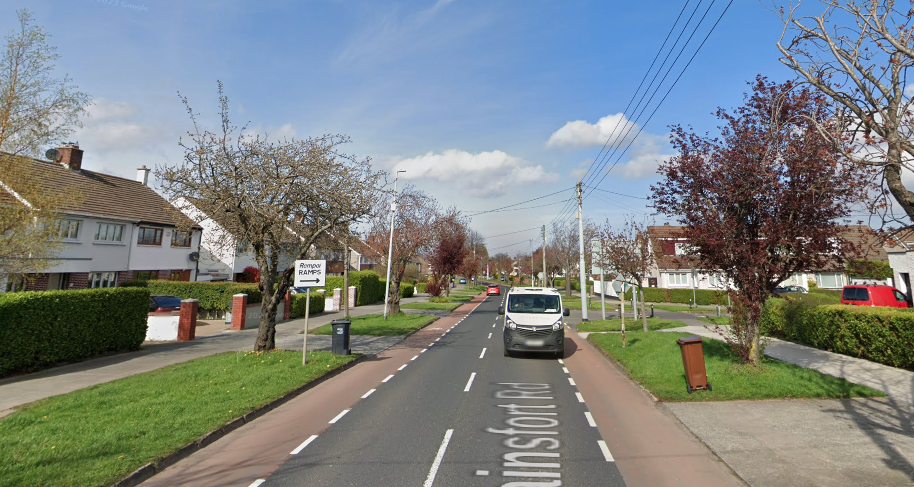
Whilst actually a wide avenue including large grass verges, the Wainsfort Road is significantly constrained in terms of its actual carriageway width. As things stand, it is not safe for cyclists to travel on the Wainsfort Road as the painted cycle track overlaps with general traffic lane at various points. Given this constraint, a Part 8 might be required from South Dublin County Council in order to widen the road a small amount in order to provide the minimum width for a bus and cyclists on each side.
Did you know? Current mobility patterns in Ireland are incompatible with the country’s target to halve emissions in the transport sector by 2030. While important, electrification and fuel efficiency improvements in vehicles are insufficient to meet Ireland’s ambitious target: large behavioural changes in the direction of sustainable modes and travel reductions are needed. – OECD 2022.
If you would like to indicate your support for the above proposals to be explored by the NTA, please take the following steps.
Next Steps
1. Leave us a comment below and/or copy this link and share on social media, local community groups, residents associations and local councillors.
2. Email it to the BusConnects team directly at info@nationaltransport.ie indicating your desire for the proposal to be considered.
Note 1: Our organisation understands that not all journeys can be made by bus or public transport and wish to remind our readers again that nobody is suggesting this. These all-or-nothing fallacies are common. Statements like “We can´t all take the bus”, “Public transport is not reliable” etc.. are valid. We all know these issues exist and that there is some fear and mistrust towards the institutions tasked with resolving these issues. However, we have also seen that this mindset can drown out the possibility of having real productive discussion about imagining solutions for a cleaner more connected city. We encourage our readers not to fall for these patterns of thinking. We also understand (and there is data supporting it) that there are a significant minority of road users in Dublin who rarely ever use public transport and some who, more importantly, are opposed to using it at all.
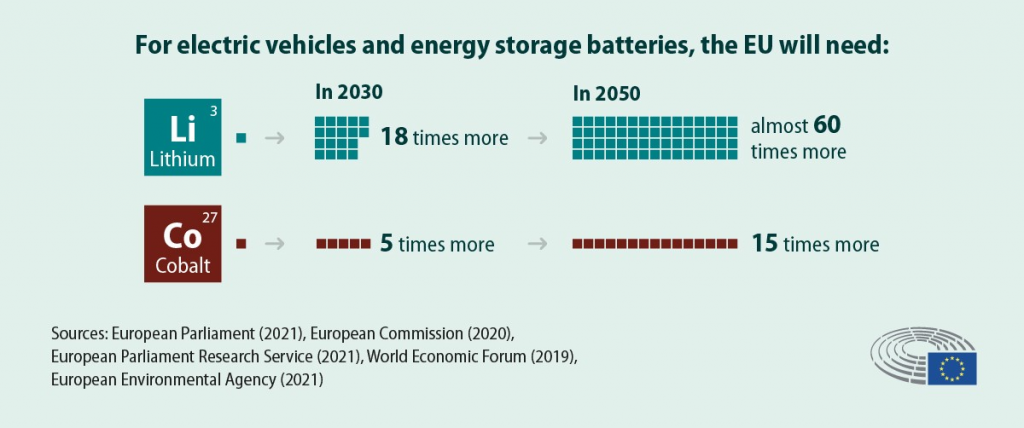
Note 2: Switching our entire transport fleet to electric is a step in the right direction but will not solve our constrained road-space problem. It will also disproportionately affect third world countries where lithium mining results in significant environmental impacts and human rights violations. Ireland needs to make the switch to electric vehicles but also decrease the net number of private vehicles in favour of more sustainable modes, particularly in urban areas with limited road-space. The answer has to be fewer cars.